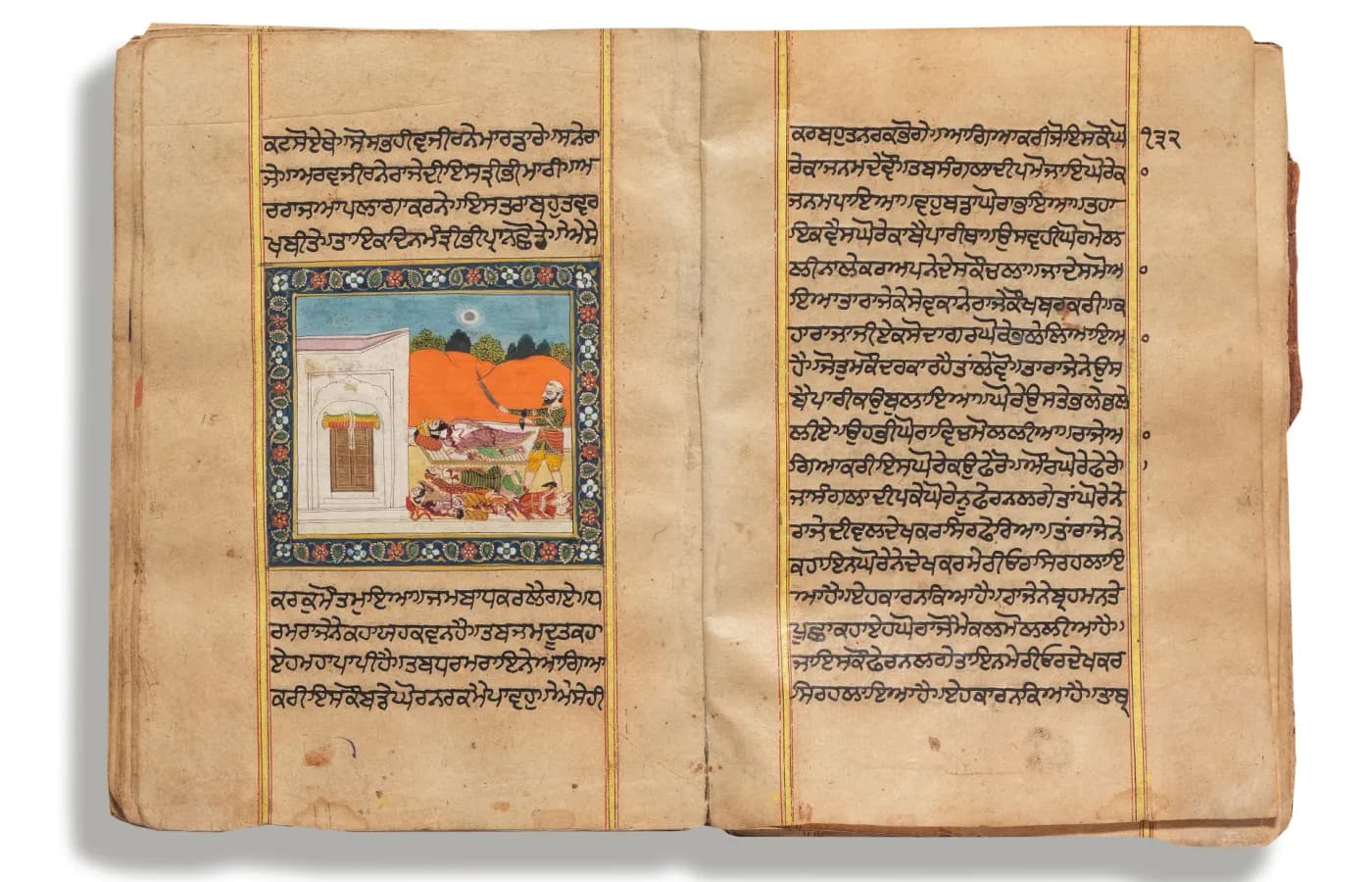
The name Gurmukhi is commonly understood as “from the Guru’s mouth.” The script was standardised and promoted by Guru Angad, the second Sikh Guru, in the 16th century, drawing on scripts already used in the region.
Gurmukhi became the script of Sikh scripture and developed into the principal script for Punjabi in India. Across the border, Punjabi is commonly written in Shahmukhi, a Perso-Arabic script. The language therefore crosses states, religions and writing systems.
A technology of access
A script is never only a set of letterforms. Standardisation supported teaching and the copying of sacred compositions. Later, lithography, movable type, newspapers and schoolbooks expanded how Punjabi circulated.
Digital type created a new chapter. Unicode encoding allows Gurmukhi to move consistently across modern devices, although good typography still depends on fonts correctly shaping vowel signs, pairings and spacing.
Every script carries design decisions, but it also carries decisions about who can read, publish and be remembered.
One language, more than one script
Treating Gurmukhi as synonymous with Punjabi erases Shahmukhi readers and the language’s shared geography. At the same time, Gurmukhi’s visual and literary history is inseparable from Sikh institutions and Indian Punjab.
Contemporary writers, designers and archivists increasingly use transliteration and dual-script publishing to reconnect readers separated by borders. The work is practical and political: making a common language visible to itself again.
Editorial note: Historical features distinguish documented facts from interpretation. Images marked illustrative do not depict the named event.